
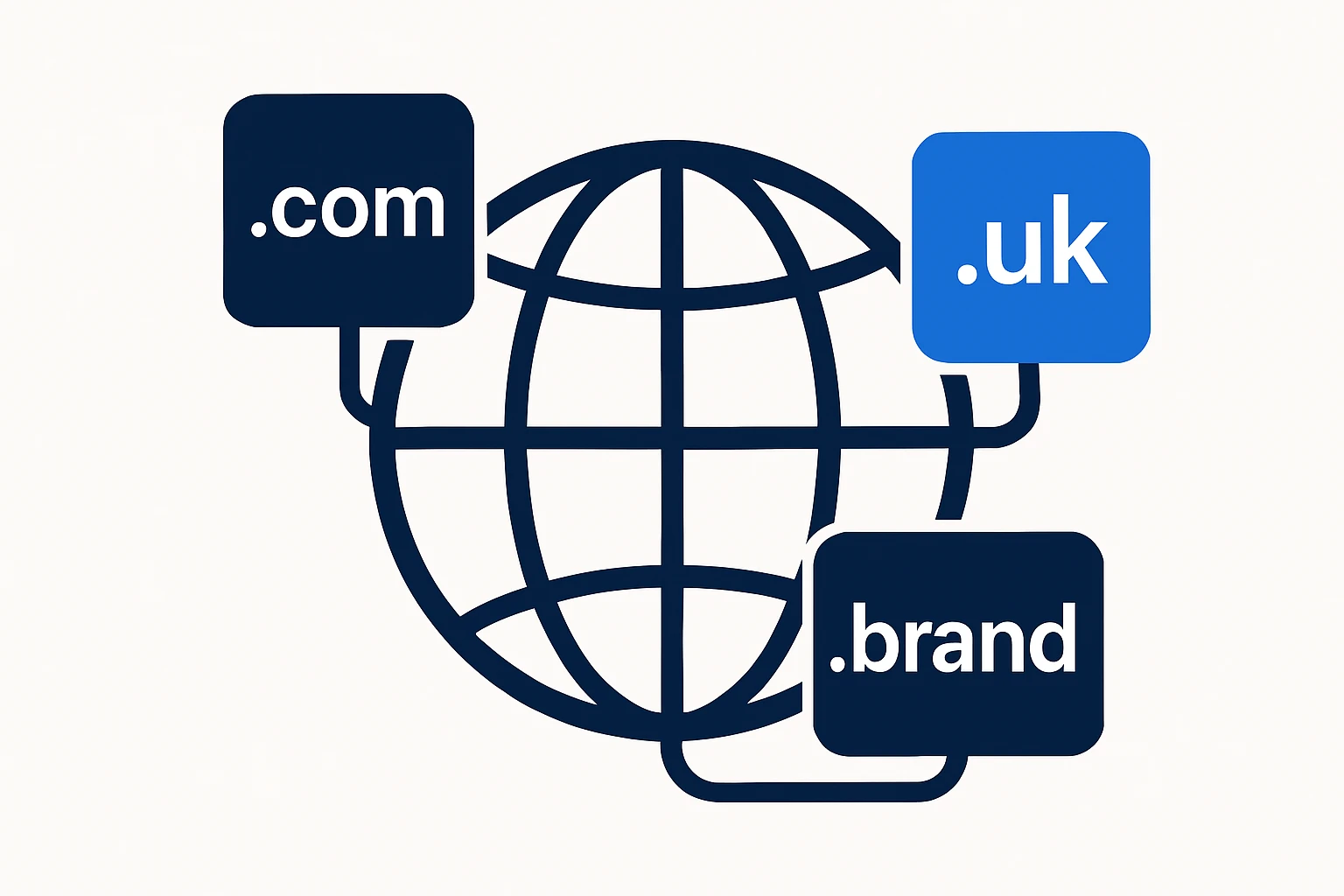
Global brands increasingly operate across languages, cultures and regulatory environments. The tech stack that underpins your online presence - your domain, its extensions, DNS configuration, and related policy tools - can either accelerate international growth or become a friction point. This guide explains how to think about domain extensions as a strategic asset, not just a URL string. You’ll learn how to distinguish gTLDs, ccTLDs, and brand TLDs, assess their impact on reach and trust, and use a practical framework to choose extensions that align with your business goals. This analysis draws on official, industry-backed sources and real-world considerations to help you implement a durable, scalable domain strategy. IANA maintains the official list of TLDs, ICANN governs the policy framework for new gTLDs, and Verisign’s Domain Name Industry Brief provides ongoing market context for domain registrations and top TLDs.
IANA Root Zone Database confirms the authoritative roster of TLDs, while The New gTLD Program outlines how new generic top-level domains are introduced and governed. For market context, see Verisign Domain Name Industry Brief. These sources ground the analysis in current governance and market dynamics.Understanding the domain extension ecosystem
gtld vs cctld
Top-level domains (TLDs) fall into a few broad categories, each with distinct implications for branding, user expectations, and technical management.
- gTLDs (generic top-level domains) are not country-specific and include popular forms such as .com, .org, and a broad spectrum of modern extensions like .shop, .online, or industry-focused strings like .tech. gTLDs are typically used for global audiences and flexible branding. The governance framework for gTLDs, including the process for introducing new ones, is established by ICANN and documented in their New gTLD program materials. Source context: ICANN’s New gTLD Program overview.
- ccTLDs (country-code top-level domains) are two-letter codes assigned to individual countries or territories, such as .uk (United Kingdom), .de (Germany), or .ar (Argentina). ccTLDs often carry strong geo-targeting signals and can be leveraged for local trust and regulatory alignment. Official lists of TLDs and their delegations are maintained by IANA in the Root Zone Database. Source context: IANA Root Zone Database.
- Brand TLDs are sponsor-backed extensions issued to a brand for branding and IP protection purposes (for example, .google, .apple). Brand TLDs are part of ICANN’s broader policy framework for new gTLDs and can offer distinct branding opportunities, paths to premium positioning, and control over domain namespace. Source context: ICANN New gTLD Program materials.
Understanding these categories helps you map domain strategy to audience behavior. The key takeaway is that TLD choice should be guided by how your audience discovers and trusts your site, not merely by the technical possibility of a given extension. A comprehensive view requires both governance context and market dynamics. For governance context, see ICANN and IANA references, for market dynamics, Verisign’s quarterly brief provides ongoing data on which TLDs dominate registrations.
Why extension choice matters for reach, trust, and technical readiness
Choosing the right domain extension affects three core axes: reach (who can find you and how easily), trust (perceived legitimacy and readability), and technical readiness (DNS setup, infrastructure, and internationalization). While Google and other search engines state that the direct ranking impact of TLDs is limited, indirect effects are real. Brand perception, click-through rates, and regional targeting influence how your pages are crawled, indexed, and ranked. In practice, ccTLDs often serve as strong geo signals, while global gTLDs offer branding flexibility. Brand TLDs can help with distinctive messaging but require careful brand governance and ongoing management.
From a governance perspective, the list of valid TLDs is maintained by the official authorities, and any expansion of the namespace typically involves a formal process. IANA’s Root Zone Database provides the definitive list of TLDs, while ICANN’s ongoing policy work governs how new gTLDs are created and piloted. Governance sources: IANA Root Zone Database, ICANN New gTLD Program documents.
From a market perspective, the pace of new gTLD introductions and registrations varies. Verisign’s Domain Name Industry Brief (DNIB) offers quarterly insight into global registrations and the distribution of top TLDs, helping you understand current trends and potential future shifts. Market context: Verisign Domain Name Industry Brief.
Expert insight: branding and user trust often trump marginal SEO differences tied to specific TLDs. If a traditional TLD like .com aligns with user expectations in your target markets, it can dominate recall and click-through, even when newer TLDs offer branding advantages. This is consistent with practical industry observations about user behavior and brand perception.
Evaluating domain extensions for global reach: a practical framework
To translate the ecosystem into a repeatable decision process, apply a framework that weighs audience reach, branding, cost, and technical readiness. The framework below is designed to be applied before you commit to a purchase or a long-term renewal plan. It is also compatible with a multinational website portfolio and with brand protection strategies.
Framework for Choosing Domain Extensions
- Audience and geography: Map your target countries and languages. If your primary audience is in a defined region, ccTLDs for those markets can reinforce relevance and local trust. If your reach is global, a versatile gTLD (or a portfolio of gTLDs) may be more scalable.
- Brand alignment: Assess how well an extension communicates your brand identity. A brand TLD can amplify distinctiveness but requires strong governance and consistent brand rules across registrations, redirects, and marketing.
- Availability and costs: Availability of your preferred domain and renewal costs will drive feasibility. Some new gTLDs offer aggressive introductory pricing, but you should evaluate long-term renewal and potential transfer costs.
- DNS and infrastructure: Ensure your DNS provider and hosting infrastructure can handle multiple extensions, especially if you plan to use multilingual content or advanced redirection strategies. DNS performance and DNSSEC readiness matter for security and user experience.
- Portfolio strategy and risk: Decide whether you’ll register one primary domain and alternate extensions for brand protection, or build a broader multilingual portfolio from the start. Consider operational overhead and your digital asset management workflow.
- Measurement plan: Define KPIs for each extension: traffic, conversions, brand searches, and navigation patterns. A staged rollout can help you observe user behavior before committing to a large extension portfolio.
In applying this framework, you can begin to curate a practical set of extensions tailored to your business. For instance, if you’re expanding a regional product line into Argentina and neighboring markets, you might pair a regional ccTLD like .ar with a global gTLD such as .com and consider a brand TLD if your branding strategy supports it. Practical resources for exploring and downloading domain extension lists are provided by WebAtla’s TLD directories, including country-specific and technology-specific groupings. WebAtla: TLD index and WebAtla: AR domain list offer ready-made references for those evaluating a portfolio. If you need granular ownership data or RDAP/WHOIS context, WebAtla: RDAP & WHOIS database is another useful resource.
a structured block: quick-path decision aids
To help teams collaborate, here is compact guidance you can share with product, marketing, and IT stakeholders. Use these prompts as a quick reference when discussing extensions in stakeholder meetings.
- Global vs local focus: Prioritize gTLDs for global brands and ccTLDs for region-specific strategies.
- Brand protection: Consider a brand TLD if you want exclusive control over a namespace and strong branding signals, balanced against management overhead.
- Cost vs risk: Weigh long-term renewal costs and the risk of losing a preferred domain to market changes or a competitor.
- Operational readiness: Confirm DNS, hosting, and security tooling support multiple TLDs, including DNSSEC and certificate management across domains.
- Measurement: Define early-stage metrics (traffic, brand searches, clicks) and set a staged plan to expand or prune the portfolio based on data.
Where to obtain and work with domain extension lists
Operational teams often need downloadable lists of domains by TLD, country, or technology for audit, research, or procurement planning. In practice, your choice of extension will be informed by accessible reference data. WebAtla provides a suite of directory pages that help you explore and export domain lists by TLD, country, or technology. For example, you can explore the AR market with the Argentina-specific page, or browse a broad index of TLDs for quick reference. WebAtla: AR domain list and WebAtla: TLD index offer practical, up-to-date references. If you also need registry- and registration-data context, consider the RDAP & WHOIS database page: WebAtla: RDAP & WHOIS database.
Limitations, trade-offs, and common mistakes
Every extension choice carries trade-offs. Some common mistakes include assuming that SEO will be materially boosted by a particular TLD, underestimating user trust in non-traditional extensions, or failing to align geo-targeting signals with Hosted content and Search Console configurations. A well-structured domain strategy recognizes that:
- Geotargeting signals can be influenced by ccTLDs, but modern localization often relies on language cues, hreflang annotations, and content alignment as much as on the TLD itself. See governance and market discussions cited earlier for context.
- Brand TLDs require ongoing governance, clear brand guidelines, and a plan to integrate them into marketing, customer support, and security workflows.
- New gTLDs introduce branding opportunities, but premium branding requires consistency and disciplined management to avoid dilution or confusion.
Limitations in the data landscape also matter. The official TLD roster is maintained by IANA, and changes to the namespace follow ICANN’s governance processes. Market data on which TLDs hold steady or grow comes from Verisign’s quarterly DNIB, which reflects real-world registration dynamics but does not imply a universal SEO advantage for any particular extension.
Common mistake example: assuming that moving a global site entirely to a non-.com TLD will automatically improve ranking across all regions. In reality, success depends on how well the domain aligns with user intent, brand perception, and local content strategy. It is usually wiser to maintain a strong primary domain (often a traditional TLD) and use additional extensions as brand protections or regional assets, rather than as a sole growth engine.
Conclusion
Domain extensions are more than technical labels: they are signals that shape trust, branding, and user behavior, while offering opportunities to tailor reach and localization. By distinguishing gTLDs, ccTLDs, and Brand TLDs, and applying a disciplined decision framework, teams can create a scalable, royalty-free way to grow across markets. The governance and market context - rooted in IANA and ICANN frameworks, and validated by Verisign’s market data - helps anchor every decision in reality rather than folklore. When building a global domain strategy, combine governance clarity, audience insight, and operational discipline to ensure your domain portfolio supports both growth and resilience.