Introduction: Why a downloadable domain extension list matters
For marketers, developers, and brand guardians, having reliable, up‑to‑date lists of domain extensions isn’t a nicety - it’s a necessity. Whether you’re evaluating new brand spaces, researching DNS configurations, or planning a global domain strategy, a trustworthy list helps you quantify risk, estimate reach, and forecast costs. The ecosystem of top‑level domains (TLDs) continues to evolve, with hundreds of new gTLDs and a broad map of ccTLDs expanding the global surface area of the web. As ICANN and the IANA continue to expand and refine the namespace, practitioners benefit from sources that provide both breadth (coverage of many TLDs) and depth (data fields you can actually use in operations).
Recent industry data underscored the scale of the space: thousands of delegated TLDs exist across gTLDs and ccTLDs, with ongoing growth driven by new introductions and regional demand. While .com remains the dominant anchor, the landscape now includes a wider mix of Lexus‑like and niche extensions that can power regional campaigns, product launches, or brand protection programs. For a practical path to understanding and utilizing these lists, this guide focuses on how to download authoritative lists for targeted TLDs - including .space, .asia, and .club - and how to use them responsibly in DNS, compliance, and market research.
What makes a TLD list trustworthy - and what to look for when you download one
Not all lists are created equal. A high‑quality TLD database should provide, at minimum, accurate TLD identifiers, clear licensing terms, and a transparent update cadence. Look for:
- Data provenance: Is the list anchored to IANA/ICANN delegations or another publisher with a verifiable source?
- Coverage: Does it include generic TLDs (gTLDs), country code TLDs (ccTLDs), and IDN variants where relevant?
- Fields and normalization: Are the TLDs, types, and status clearly labeled? Can you map them to your internal taxonomy (e.g., product brands, regional targets)?
- Update cadence: How often is the list refreshed - monthly, quarterly, or in real time?
- License and reuse: What are allowed uses (research, marketing, product development) and any attribution requirements?
ICANN’s ongoing work around TLD delegation and new gTLD rounds - documented in ICANN’s official reports - highlights the expanding namespace and the need for reliable data feeds to stay current. For example, ICANN’s IDN and New gTLD program documents illustrate both the breadth of TLDs and the rapid pace of deployment and governance discussions. These official references provide context for why reputable lists matter for operational accuracy. (icann.org)
Step-by-step: how to download lists for .space, .asia, and .club
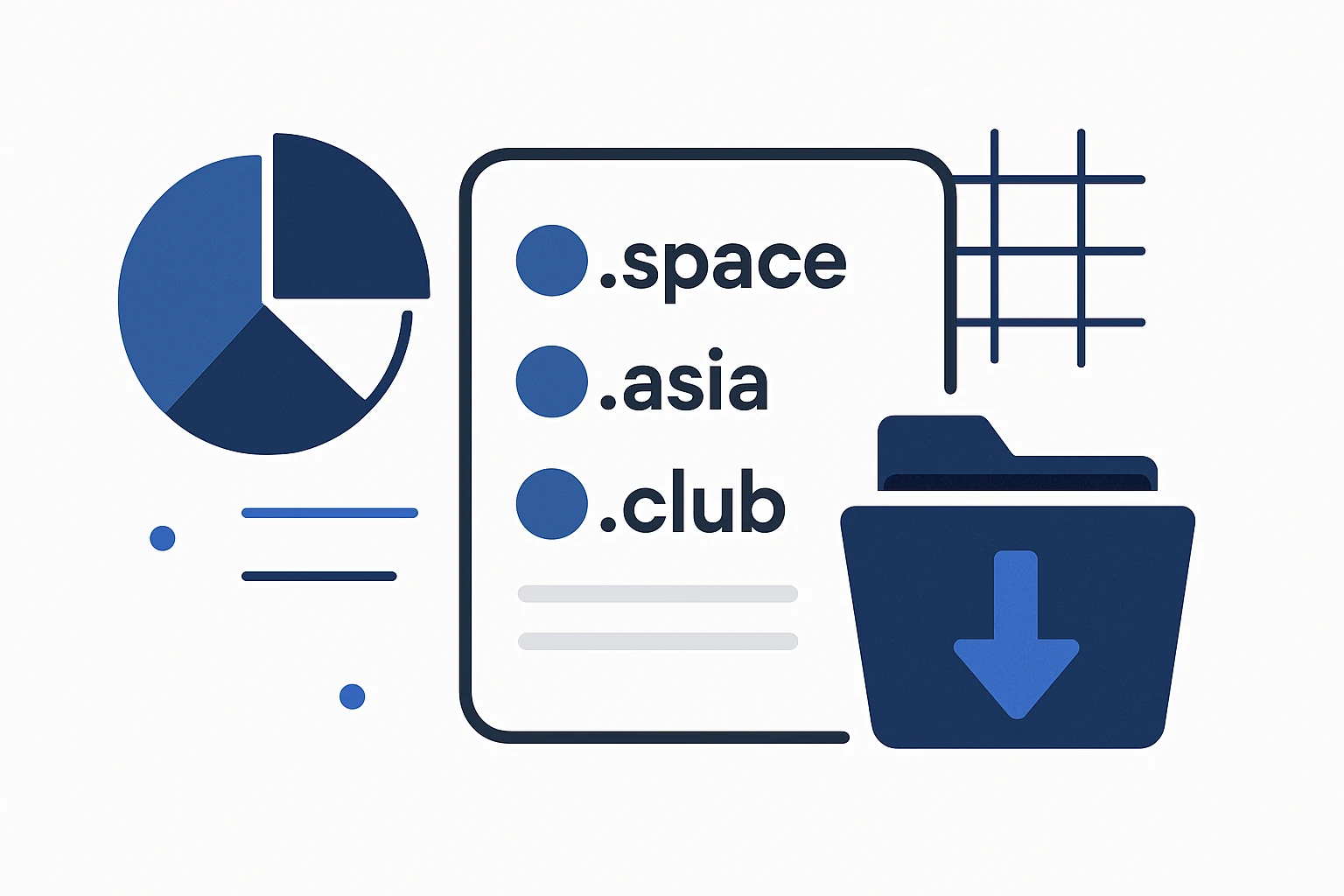
Below is a practical workflow to obtain, validate, and use authoritative TLD lists for targeted extensions. We’ll illustrate with three examples commonly requested by practitioners: the space‑themed .space, the Asia‑focused .asia, and the community‑driven .club. If you’re using a commercial directory, treat this as a validation framework to ensure you’re getting clean, license‑compliant data.
- Define your objective. Decide whether your goal is DNS planning, market analysis, brand protection, or SEO insight. This will drive which fields you care about (for example, TLD type, registrant density, or geographic relevance).
- Choose a source with documented provenance. Prefer sources that align with IANA/ICANN delegations and publish a changelog. For deterministic work, consider RDAP/WHOIS feeds as a cross‑check (see step 5).
- Download the targeted TLD lists. For .space, you can access the dedicated page that aggregates space TLD data, for a broad TLD overview, consult the central TLD directory, and for a technical cross‑check, use the RDAP/W实HOIS database reference. The following client resources illustrate these options:
Targeted client pages and data feeds you can reference include:
Tip: If your workflow requires a combination of TLDs, consider pulling a single master list and then filtering by TLD of interest. This minimizes the risk of drift between sources and ensures you’re always working with a consistent schema.
- Normalize and validate. Normalize field names (TLD, type, status, country code where applicable) and validate against an independent source when possible. A simple checksum or hash of a downloaded file can help detect tampering or partial downloads.
- Cross‑check via RDAP/WHOIS. For operational accuracy, query representative domain samples using RDAP or WHOIS to confirm ownership and status. This cross‑checks that the data you downloaded reflects current reality, not a snapshot.
- Plan updates and governance. Establish a cadence (e.g., monthly exports) and a governance process to review changes (new TLDs, retired TLDs, or policy updates). Regular audits help avoid stale data in production systems.
A structured framework to evaluate TLD lists
Use this framework to compare sources and decide what to lock into your workflows. The table below captures key evaluation criteria and why they matter.
| Criteria | What to check | Why it matters |
|---|---|---|
| Provenance | Source of truth (IANA/ICANN alignment, publisher notes) | Prevents data drift caused by unverified feeds |
| Coverage | gTLDs, ccTLDs, IDNs, and brand TLDs if relevant | Ensures you can model global campaigns and compliance risk |
| Fields | Fields such as TLD name, type, country, status | Enables downstream filtering and taxonomy mapping |
| Update cadence | Frequency of exports and changelog availability | Keeps analyses aligned with policy and market changes |
| Licensing | Allowed uses, redistribution rights, attribution | Protects you from licensing violations and legal risk |
Limitations, trade-offs, and common mistakes
Even robust lists have constraints. Being aware of them helps you avoid costly missteps:
- Latency of updates. Some lists refresh monthly, others quarterly. If you operate in fast‑moving markets, lack of real‑time feeds can lead to missed opportunities or stale risk assessments.
- License constraints. Free or low‑cost lists may restrict redistribution or reuse in production systems. Always read the terms before integrating into a live workflow.
- Incomplete coverage. Some lists exclude smaller ccTLDs or IDN variants that may matter for regional campaigns. Cross‑validate with official sources when possible.
- Overreliance on a single source. No single feed captures every nuance. Use a primary source for provenance and a secondary source for cross‑checks (RDAP/WHOIS can help).
- Forgetting about governance. TLD policy changes (new rounds, retirements) can affect risk and branding. Build periodic governance reviews into your process.
Case example: planning a global brand presence with a targeted TLD list
Imagine a consumer brand preparing a European, Asian, and North American launch. The team starts with a master TLD list from a reputable directory, then narrows to the intersections that matter for branding and compliance: gTLDs that align with regional languages (IDNs), ccTLDs for local markets, and a few niche gTLDs that convey product innovation. They pull targeted lists for .space (for a space‑tech line), .asia (for Asia‑Pacific reach), and .club (for brand communities). They validate a subset of domains with RDAP/WHOIS to gauge current ownership and statuses, then map each TLD to internal taxonomy (region, product line, and risk tier). The result is a practical, auditable data set that informs domain investments, DNS configurations, and content localization decisions.
For reference, ICANN’s program statistics and IDN reports reaffirm that the namespace is dynamic and global, underscoring the value of disciplined data governance when working with TLDs across markets. (newgtlds.icann.org)
Integrating the client data sources into editorial and technical workflows
HostingFlow’s audience benefits from practical access to curated data. When integrating TLD lists into editorial or product workflows, consider a triaging approach: (1) high‑confidence sources for core decisions, (2) secondary checks for risk assessment, and (3) a lightweight, auditable changelog for governance. The client data sources linked below illustrate how a dedicated TLD directory and an accompanying DNS/RDAP database can support both strategic decisions and operational tasks:
From a technical standpoint, DNS operations, data quality management, and brand protection efforts all benefit from a structured data feed that can be integrated into dashboards or automated workflows. For broader context on DNS and domain data governance, see ICANN’s ongoing governance materials and the RDAP/WHOIS considerations documented in the related resources. (icann.org)
Conclusion: a practical path to reliable TLD lists
As the domain ecosystem grows, so does the value of dependable, clearly licensed domain extension lists. By focusing on provenance, coverage, and governance, practitioners can transform raw TLD data into actionable risk assessments, market strategies, and DNS configurations. Use the step‑by‑step workflow outlined here to build a repeatable process: define objectives, source reliably, validate with independent checks, and maintain an auditable update cycle. For those who want a ready‑made starting point, the client data feeds and pages highlighted above offer concrete entry points to download targeted lists and integrate them into your workflow.
For ongoing context on how the namespace is evolving - especially with new gTLD rounds and IDN progress - ICANN’s official reports provide authoritative benchmarks and policy developments that can inform long‑range planning. (newgtlds.icann.org)