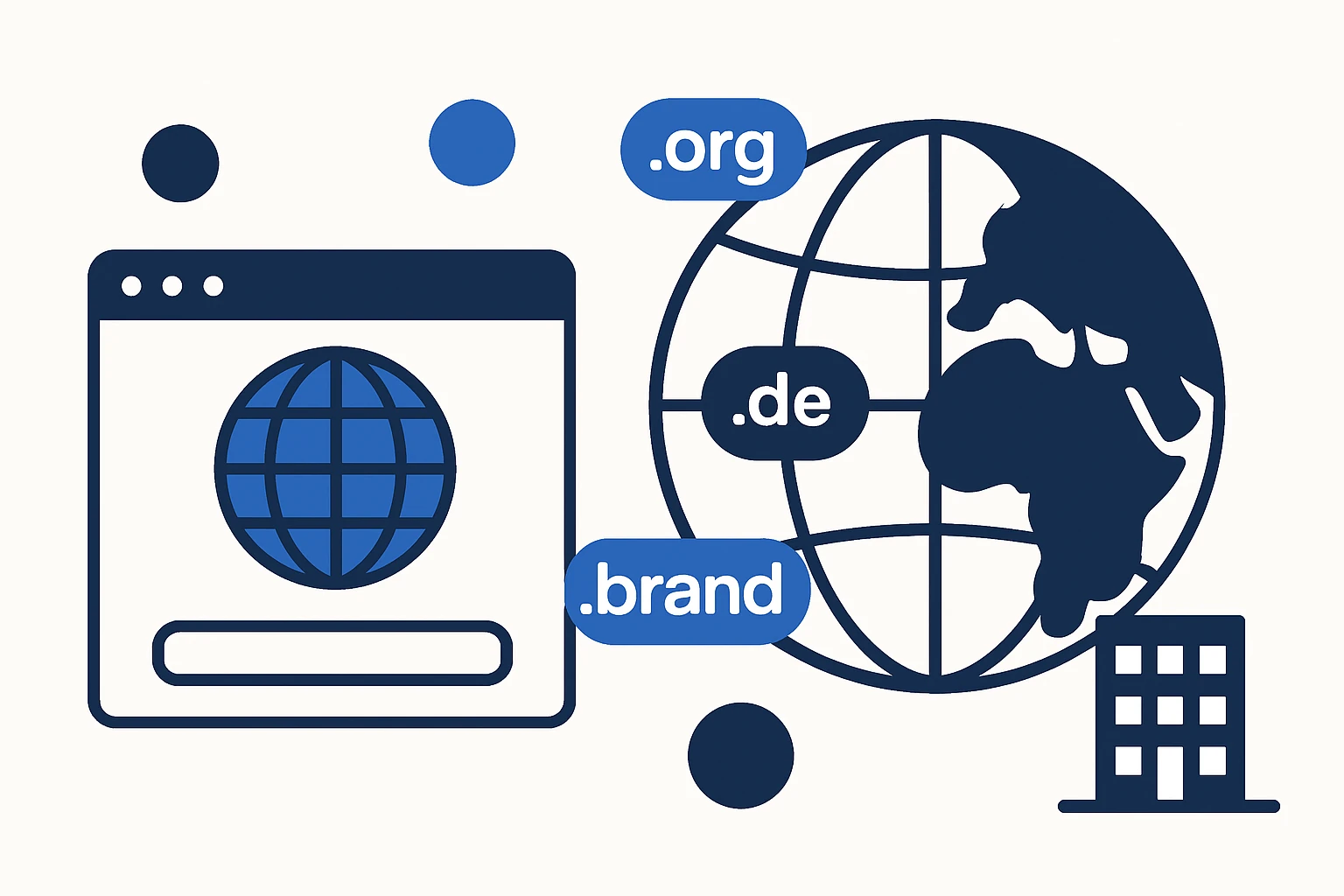

Introduction: why the right domain extension matters for brands in 2026
Choosing a domain extension is more than a cosmetic preference, it shapes how a brand is perceived, where it can operate most effectively, and how easily customers can find and trust it online. As the domain landscape continues to expand - with a mix of generic, country-code, and new generic top-level domains - the decision requires a clear framework. In 2025, Verisign reported hundreds of millions of domain registrations worldwide, with the global domain base still growing as businesses pursue broader digital footprints. This growth is distributed across gTLDs, ccTLDs, and the burgeoning space of new gTLDs, each carrying distinct advantages and trade-offs for branding, SEO, and governance. Understanding the landscape is the first step toward a robust, future-proof strategy.
The Domain Name System (DNS) underpins every domain decision. DNS translates human-friendly names into machine-understandable addresses, and the top-level domain layer is the anchor for policy, security, and user expectations. For readers who want a deeper dive into the DNS, ICANN and IANA provide authoritative context on how TLDs are managed and how the root zone relates to the entire namespace. The Domain Name System (DNS) – ICANN and Root Files - IANA offer foundational explanations for why extensions exist the way they do and how they are delegated. Key takeaway: TLD choice interacts with policy, registry rules, and global reach - so it’s not just a link in a menu.
Understanding the landscape: GTLDs, ccTLDs, and new gTLDs
Top-level domains fall into three broad categories: generic top-level domains (gTLDs), country-code top-level domains (ccTLDs), and the post‑2012 era of new gTLDs. Each category serves different strategic aims, and the differences are not merely administrative, they influence branding, regional strategy, and technical considerations.
What is a TLD, and how does it affect branding and SEO?
The DNS treats the top-level domain as the final segment of a domain name. From a user perspective, a TLD can signal context (global vs regional), trust, and even compliance expectations. For example, ccTLDs often align with local audiences and regulatory environments, while established gTLDs like .com carry universal familiarity. DNS remains the backbone that makes these distinctions meaningful, it maps a domain name to its underlying infrastructure, enabling reliable resolution across the globe. For a concise overview of how the DNS works and why TLDs matter, see ICANN’s DNS explainer and the IANA root zone listing. The Domain Name System - ICANN • Root Zone Database - IANA.
GTLDs vs ccTLDs: benefits, trade-offs, and when to use each
- Global reach with gTLDs: gTLDs are designed for international or universal use and are often perceived as globally scalable. They tend to have broad registration policies and well-established registrars, which can simplify global campaigns.
- Local relevance with ccTLDs: ccTLDs signal local focus and compliance with country-specific domains, privacy laws, and consumer expectations. They can drive local trust and improve regional search relevance in certain markets.
- New gTLDs as niche signals: The post-2012 expansion allowed brands to signal category or industry (for example, technology, shopping, education) but with mixed adoption patterns - some new gTLDs achieve strong niche traction, while others rely on branding and marketing to gain recognition.
Deciding between a gTLD and a ccTLD is often a balancing act: scale and simplicity versus local relevance and regulatory clarity. Industry observers often point to policy differences, registry rules, and renewal risk as critical factors. For an overview of policy differences and practical implications, see DN.org’s analysis of gtld vs ccTLD differences. gtLTD vs ccTLD policy differences.
New gTLDs introduced in the 2010s and beyond have reshaped what is possible in branding online. ICANN has documented the program’s ongoing achievements and community engagement, which continues to influence how organizations approach domain portfolios. ICANN: The Latest New gTLD Program Achievements.
The role of new gTLDs: why the space matters (and when to prefer it)
New gTLDs offer opportunities to match brand identity with a domain extension that reinforces a message or product category. They can help with branding clarity when traditional extensions are crowded or commoditized. However, new gTLDs often come with considerations around awareness, trust, and SEO dynamics that differ from legacy gTLDs. When evaluating new gTLDs, organizations should weigh:
- Registrant traffic and brand recognition in target markets
- Registration and renewal costs, as well as potential trademark risks
- Registry policies, dispute resolution mechanisms, and security features
For a broader sense of how new gTLDs fit into the global ecosystem, the DNIB data and ICANN’s program information provide useful context about adoption patterns and ongoing policy developments. The quarterly Domain Name Industry Brief (DNIB) is published by Verisign and is widely used by practitioners to gauge the health and direction of the market. DNIB – Q2 2025.
A practical framework for domain extension decisions
Use this five-step framework to guide portfolio decisions. It is designed to be flexible across industries while staying anchored in policy, DNS, and market realities.
- Step 1 - Define your market footprint: Are you aiming for global reach, or is your primary emphasis regional markets? If global, gTLDs may simplify management, if regional, ccTLDs can align with local search and regulatory expectations.
- Step 2 - Align with brand strategy and perception: Consider whether a domain extension will be a branding asset (e.g., signaling a category with a new gTLD) or a trust signal (e.g., a widely recognized gTLD like .com or a strong ccTLD for local markets).
- Step 3 - Evaluate DNS and technical considerations: The DNS architecture underpins reliability and performance. Ensure that your DNS provider and registrar support the chosen TLDs and offer protections like DNSSEC if needed. See ICANN’s DNS overview and Cloudflare’s DNS resources for practical deployment considerations. DNS overview • DNS basics - Cloudflare.
- Step 4 - Assess costs, risk, and policy constraints: Compare registry pricing, renewal terms, dispute resolution provisions, and country-specific requirements. IANA’s Root Zone Database and Verisign’s DNIB provide data points on pricing, renewal dynamics, and growth trends that can inform budgeting and risk assessment. Root Zone Database • DNIB Q1 2025 (PDF).
- Step 5 - Test perception and SEO signals before scaling: Run controlled tests to see how users react to different extensions, and monitor click-through rates and brand searches across portfolios. SEO signals are nuanced but tangible, with global domain registrations showing sustained growth in recent quarters. For example, DNIB reports 368.4 million domain registrations across all TLDs at the end of Q1 2025, with ccTLDs and ngTLDs contributing to the mix. DNIB Q1 2025 (PDF).
Technical and policy considerations you should not ignore
Beyond branding, a domain extension interacts with technical and regulatory frameworks. DNS remains the backbone of how domain names are resolved, and understanding its basics helps you select extensions that align with your site’s resilience and performance goals. The DNS translates names to addresses and relies on a globally distributed network of servers to ensure availability. For a clear primer on how DNS works and why the root zone matters, see ICANN’s overview and the Root Zone Database. DNS – ICANN • Root Zone Database – IANA.
When selecting a TLD, it’s also worth remembering that the root zone and the list of delegated TLDs are maintained and published by IANA. This forms the authoritative basis for which extensions exist and how registries operate. See the IANA Root Files page for the latest top-level domain list and related documentation. Top-Level Domain List – IANA.
Real-world trends and data you can use
Understanding current domain statistics can help calibrate expectations around new portfolios and market opportunities. Verisign’s quarterly DNIB reports track the total number of registered domains worldwide, across all TLDs, and break down growth by gTLDs, ccTLDs, and new gTLDs. The latest quarterly data show that the global count remains in the 368–372 million range, underscoring ongoing demand for both brand protections and local digital real estate. For example, the DNIB reported 368.4 million total registrations at the end of Q1 2025, with ccTLDs contributing a meaningful share of this total. DNIB Q1 2025 – PDF. In Q2 2025, Verisign reported 371.7 million total registrations, with ccTLDs again representing a substantial portion of the portfolio. DNIB Q2 2025 – Verisign.
For context on how the ccTLD and global shares are evolving, Verisign’s quarterly data also provides the ccTLD tallies. By the end of Q2 2025, ccTLD registrations stood at around 143.4 million, illustrating the continued localization of the namespace alongside global gTLD growth. DNIB Q2 2025 – ccTLD statistics.
Limitations and common mistakes to avoid
- Over-reliance on a single TLD: A portfolio focused solely on a dominant gTLD like .com may miss regional signals that ccTLDs can provide. Diversification should be guided by market targets and brand strategy, not by fear of missing out on a particular extension.
- Ignoring DNS and security implications: Some new gTLDs lack mature DNS security and monitoring tools, which can affect site reliability and user trust. Always evaluate DNS provider capabilities, uptime histories, and DNSSEC availability before committing to a niche extension.
- Underestimating renewal and registration costs: Renewal terms vary by registry and may evolve. Build scenarios that account for currency changes, renewals, and potential legal challenges (e.g., trademark issues) in your total-cost-of-ownership model.
- Assuming user familiarity automatically transfers: While .com remains familiar to many users, newer or more regional TLDs may require marketing efforts to reach awareness and trust thresholds in target markets.
The hostingflow + webatla integration: a practical sourcing approach
To manage domain extension data and compare portfolios, a centralized directory matters. WebAtla offers practical resources that align with the needs of a structured TLD strategy, including a comprehensive directory of domains by TLDs and country-specific listings. For an up-to-date directory of TLDs and related domain lists, see WebAtla’s List of Domains by TLDs. If you are conducting registrant research or exploring WHOIS/RDAP data as part of risk assessment, the RDAP & WHOIS Database can be a valuable companion. For budgeting and plan scoping, explore WebAtla Pricing to understand variable costs by extension. These 1–3 client links are provided to illustrate a practical, editorial use of domain data in portfolio planning without compromising objectivity.
Conclusion: frame your decision, then test and iterate
The choice of domain extension is a strategic decision that blends branding, policy, and user experience. A rigorous framework - grounded in DNS fundamentals, TLD governance, and current market data - helps you move beyond intuition toward a measured portfolio strategy. As the namespace continues to evolve, it will remain essential to monitor DNS resilience, registry policies, and the ever-shifting landscape of global and regional demand. For practitioners who want a practical, data-informed reference point, the combination of authoritative DNS context (ICANN/IANA), Verisign’s market briefs, and reliable directory data from sources like WebAtla provides a balanced, future-facing view of how domain extensions can support, and sometimes accelerate, business goals.