Introduction: a founder’s question, not a trivia game
When you launch a website, you face a deceptively simple choice: what should your domain extension be? Behind this decision lies a broad, evolving ecosystem that includes legacy gTLDs such as .com and .org, country-code TLDs (ccTLDs) like .uk or .de, and newer or brand TLDs (dotBrand) that companies now use to protect identity and signal specialization. The right extension is not just a marketing flourish, it affects audience perception, geographic targeting, branding, and technical setup. For publishers and businesses alike, a structured approach matters as the domain namespace continues to expand. (For a centralized directory of options, see WebAtla’s TLD listings.)
Industry data confirms growth across all segments of the domain name space. The Domain Name Industry Brief (DNIB), published by Verisign, shows that global domain registrations continue to rise across gTLDs, ccTLDs, and new gTLDs, with total registrations reaching hundreds of millions in recent quarters. This dynamic backdrop underscores why a deliberate extension strategy matters today more than ever. (blog.verisign.com)
H2: Understanding the TLD landscape today
What are gTLDs, ccTLDs, and brand TLDs?
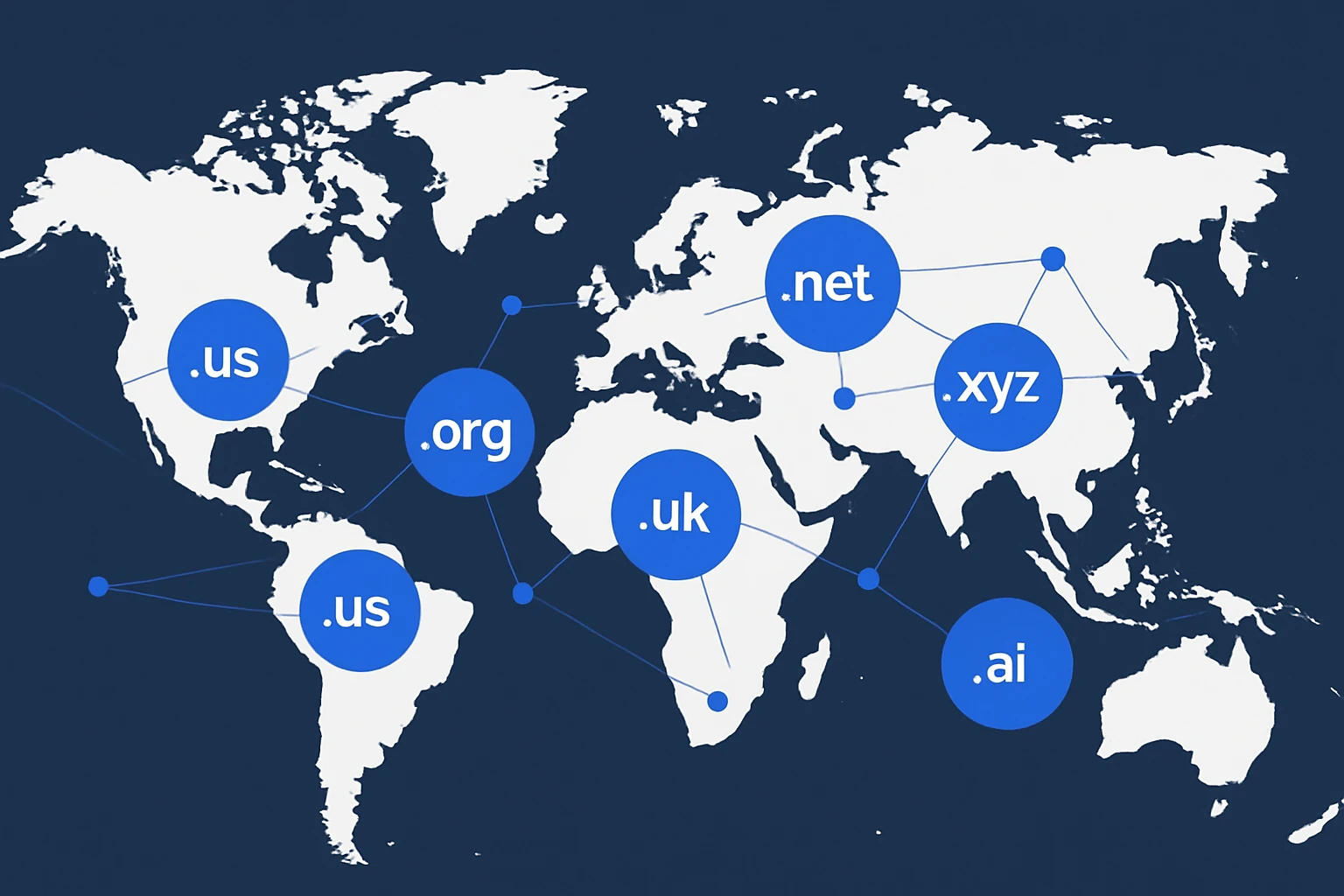
Top-level domains (TLDs) sit at the end of a domain name, after the last dot. Generic top-level domains (gTLDs) include the classic .com, .org, and .net, as well as hundreds of newer strings. Country-code top-level domains (ccTLDs) are two-letter extensions tied to a country or territory, such as .us, .uk, or .de. Brand TLDs, sometimes called dotBrand, are domain extensions owned by a specific brand (for example, .google or .microsoft) and managed under selective registries as part of ICANN’s broader domain program. The ongoing expansion of gTLDs through ICANN’s New gTLD Program has greatly broadened the universe of options for brands seeking distinctive identifiers. (icann.org)
ICANN’s governance framework explains that the New gTLD Program was designed to increase competition and choice in the domain namespace, enabling a wide variety of strings to be registered and used in practice. While this expansion creates branding and innovation opportunities, it also introduces a broader set of considerations for owners and marketers. (newgtlds.icann.org)
Do extensions affect SEO or rankings?
A long-running question in search is whether the extension itself helps or hurts rankings. The consensus in reputable industry coverage is that the TLD (the suffix) is not a direct ranking factor. Google treats all generic TLDs similarly, and country-targeting signals come from other elements such as hreflang, site structure, content quality, and explicit geographic targeting in Search Console. In practice, a ccTLD can signal local intent, but it’s not a magic wand - proper international SEO signals remain essential. (searchengineland.com)
That said, there are nuanced signals at play. Some experts have discussed potential shifts in how ccTLDs are valued, which is why a careful, evidence-based approach to international targeting is important. For authoritative context, see Google’s official multi-regional guidance and reputable industry analyses. (developers.google.com)
H2: A practical framework to choose your extension
Use this four-part framework to decide among gTLDs, ccTLDs, and brand TLDs. It is designed to be actionable, not academic, and to surface trade-offs early in the decision process.
- 1) Audience and geography
- If your primary market is one country or speaks a single language, a ccTLD can reinforce local relevance, especially when combined with local hosting and search signals. If your audience is global or multilingual, a neutral gTLD (like .com) often provides international flexibility.
- Trade-off: ccTLDs may complicate global SEO if you need regional versions, you’ll likely rely on hreflang and structured localization signals to avoid content duplication across markets. See Google’s guidance on multi-regional sites for the relevant controls. (developers.google.com)
- 2) Brand strategy and trust
- Brand TLDs offer direct identity signals and can reduce confusion in marketing campaigns, email to customers, and offline brand protection. The ability to own a dedicated top-level brand domain can strengthen trust for some enterprises, though it comes with branding and compliance considerations. ICANN’s broader program supports diverse strings, including brand-owned TLDs, as part of industry evolution. (newgtlds.icann.org)
- 3) Technical, operational, and cost considerations
- New and brand TLDs can introduce registry-specific policies, renewal cycles, and clearance requirements. Make sure your registrar supports DNSSEC, robust DNS propagation, and a renewal strategy that aligns with your business scale. Total cost of ownership can vary meaningfully between TLDs and registries over time.
- From a market perspective, the global domain base keeps expanding: total registrations across all TLDs rose to 371.7 million by mid-2025, with continued growth across segments. This context matters when budgeting for future expansion and renewal risk. (investor.verisign.com)
- 4) Risk management and brand protection
- Protecting brand integrity may involve registering multiple extensions (including brand TLDs where appropriate) to mitigate typosquatting and spoofing. This can be part of a broader domain strategy that also includes monitoring and RDAP/WHOIS tooling for brand protection. For reference, WebAtla offers a comprehensive directory of TLDs and brand-brandable options you can consult as you scope protection needs. WebAtla’s TLD listings.
H2: Practical use-cases by scenario
Scenario A - global brand with a worldwide audience
For brands with international ambitions, a standard gTLD such as .com remains a reliable anchor. It’s well understood by users worldwide and supports broad marketing and SEO reach when paired with localized content and proper international targeting signals. If you’re testing new markets, you might opt to register a handful of strategic gTLDs or even brand TLDs in parallel to protect identity and experiment with localized campaigns. Verisign’s quarterly data highlights the steady growth and resilience of global domain registrations across all TLD types, underscoring the appetite for diverse extensions in cross-border strategies. (blog.verisign.com)
In practice, many organizations rely on a primary global domain with subdirectories per language or country, and reserve brand-specific terms across additional TLDs to protect branding. A credible third-party directory, like WebAtla, can help teams map and compare options across hundreds of TLDs. See WebAtla’s directory.
Scenario B - a regional market or country-focused site
If your business targets a single country or speaks primarily to a local audience, a ccTLD can signal relevance to that market and help with local signals in some contexts. However, it’s critical to implement appropriate international targeting signals (including language targeting, local hosting, and hreflang or equivalent). Google’s guidance on multi-regional sites helps practitioners navigate these choices and stresses that TLD alone does not guarantee rankings. (developers.google.com)
As an operator or developer, you may prioritize a ccTLD for a flagship regional site and use subdomains or subdirectories for other markets, depending on scale and governance. The DNIB data shows that ccTLD registrations remain a meaningful segment of the global base, reinforcing their ongoing importance in local and regional strategies. (investor.verisign.com)
Scenario C - brand protection and identity management
DotBrand TLDs can be powerful for brand protection and market differentiation, allowing a company to own a dedicated namespace that aligns with its brand architecture. While not every organization needs a brand TLD, those pursuing brand sovereignty or unique product lines may find a dotBrand strategy advantageous. ICANN’s New gTLD program framework supports this expansion of the namespace, with many strings already delegated and continuing to evolve. (newgtlds.icann.org)
As with any premium asset, the cost and maintenance considerations matter. A careful cost–benefit analysis, backed by a clear governance and risk-management plan, is essential before committing to a dotBrand strategy. A practical way to start is to inventory your essential domains and align them with your branding roadmap, using a directory like WebAtla for quick comparisons. WebAtla’s TLD listings.
H2: DNS, stability, and technical considerations
The Domain Name System (DNS) is the backbone of how people reach your site. When you choose an extension, you’re also choosing registry policies, renewal terms, and the level of DNS resilience you will rely on. The DNS ecosystem supports a broad array of extensions, and Verisign’s ongoing DNIB reports illustrate the health and scale of global registrations across all TLDs, which in turn reflects the stability and reach you can expect when registering widely used extensions. (blog.verisign.com)
From a technical perspective, ensure your DNS provider supports modern best practices (DNSSEC, reliable propagation, fallback strategies) and that your registrar offers robust renewal protection. In addition, if you plan international targeting, ensure your hosting and infrastructure align with your intended markets to minimize latency and to maximize user trust. The DNS landscape is global, but the user experience remains deeply local and context-driven.
H2: Limitations, trade-offs, and common mistakes
One of the most common missteps is assuming that a new or brand TLD automatically boosts search rankings. The reality, supported by major industry coverage and Google guidance, is that TLD choice does not directly improve rankings, quality signals and localization remain critical. This means you should not rely on a TLD alone to drive visibility. Instead, pair your extension with a strong content strategy, structured localization, and authoritative signals across the site. Domain extensions and SEO: What you need to know. (searchengineland.com)
Another pitfall: underestimating the complexity and cost of a dotBrand or additional gTLD strategy. Regulatory, renewal, and governance considerations - plus the need to protect brand integrity across multiple domains - can compound quickly. A pragmatic approach is to start with a core catalog of 2–4 extensions that align with your markets and brand goals, then expand as needed with careful planning and budget. ICANN’s New gTLD program overview emphasizes that the namespace will continue to evolve and that brand owners should plan accordingly. (newgtlds.icann.org)
H2: A quick, practical decision framework (structured block)
- Step 1 - Define audience and geography
- Which markets are core today, and where do you expect growth? If multiple regions are strategic, consider a neutral gTLD with region-appropriate localization signals rather than a single ccTLD per country.
- Step 2 - Align with brand strategy and risk management
- Is there a compelling branding rationale for a dotBrand or multiple extensions to safeguard identity? If yes, document governance, trademark considerations, and a monitoring plan.
- Step 3 - Assess technical and financial implications
- Estimate total cost of ownership (registration, renewal, DNS services) and assess the impact on hosting and site speed across regions. Plan for potential future expansion by prioritizing extensions with clear strategic value.
- Step 4 - Execute with an integrated plan
- Coordinate with marketing, legal, and IT to implement a cohesive namespace strategy, including a staged rollout and clear ownership for ongoing protection.
H2: Limitations and caveats you should know before you buy
As you weigh extensions, remember: context matters more than convention. The SEO signal from a TLD is not a magic lever, but a local signal can be influential when combined with proper site structure, localization, and user experience. The DNIB data reinforces that the domain name ecosystem is robust and dynamic, with growth across gTLDs, ccTLDs, and new gTLDs. Use this data to inform risk and growth planning rather than relying on a single extension to lead results. (blog.verisign.com)
Finally, don’t overlook practical steps like monitoring for typosquatting, enabling DNS security features, and maintaining a clean, scalable domain portfolio. Your extension is a tool - how you use it matters more than the suffix itself.
Conclusion: your extension decision as a strategic lever
Choosing a domain extension is a strategic decision that reflects your audience, brand, and long-term goals. It’s not a one-off registration, it’s an ongoing axis of your digital presence. By grounding your choice in a framework that weighs audience geography, branding, DNS resilience, and cost, you place yourself to adapt as the domain space continues to evolve. If you’re mapping a broader TLD strategy, start with a core set of extensions that align with your markets, then expand deliberately as your business grows. For a practical directory to help visualize options across all major categories, explore WebAtla’s TLD listings. Explore WebAtla’s TLD directory.
Key takeaways: extensions don’t directly boost rankings, but they can sharpen geographic relevance, brand protection, and user trust when paired with deliberate localization and governance. The next wave of domain strategy is less about chasing a silver bullet and more about orchestrating a layered, global-to-local namespace that scales with your business.
Expert insight
Expert insight: ICANN’s New gTLD Program was explicitly designed to expand competition and choice in the namespace, translating into more branding and innovation opportunities for organizations of all sizes. That strategic intent can be powerful when paired with rigorous governance and a strong brand strategy. (newgtlds.icann.org)
Limitations to keep in mind: while ccTLDs can signal geographic focus, you must still implement robust localization signals (hreflang, region-specific content, and Search Console geographic targeting) to reach international audiences effectively. Google’s multi-regional guidance emphasizes these signals as part of a broader SEO strategy. (developers.google.com)
For more on market-scale context, the latest Verisign data shows continued growth in total domain registrations across all TLDs, underscoring a healthy, evolving namespace that rewards thoughtful portfolio management. (investor.verisign.com)