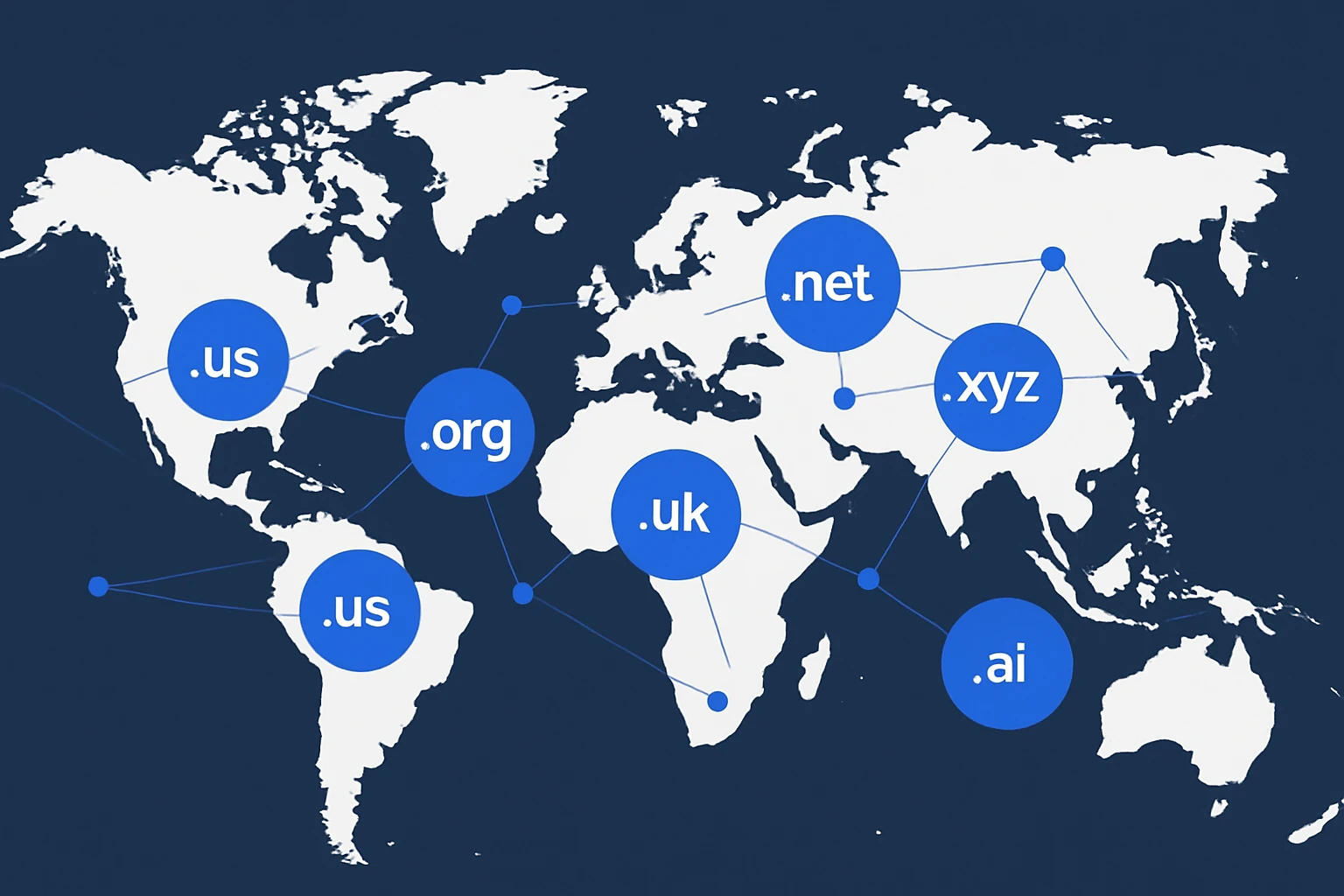
Choosing the right domain extension is more than a branding choice. It shapes user trust, geographic targeting, and long‑term stewardship of your online presence. As the global namespace continues to expand - ICANN reported a broad, growing set of TLDs in the root zone, with thousands of delegated TLDs in circulation - the decision remains a strategic one for product teams, marketers, and IT leaders alike. This guide walks you through the ecosystem, separates common myths from practical realities, and provides a decision framework you can apply today. ICANN notes that as of mid‑2025 there were about 1,440 TLDs delegated into the root zone, underscoring how diverse the landscape has become. ICANN Glossary also clarifies the main TLD categories you’ll encounter: generic top‑level domains (gTLDs), country code top‑level domains (ccTLDs), and the specialized sponsored and infrastructure variants.
What the TLD landscape looks like in 2026
The top‑level domain (TLD) space is organized around a few core categories, each with distinct implications for branding, targeting, and governance. Understanding these categories helps you map your audience, protect your brand, and design a future‑proof domain strategy.
gTLDs vs ccTLDs: the core difference
Generic top‑level domains (gTLDs) are the broad, non‑geographically constrained extensions such as .com, .org, and .net. Country code top‑level domains (ccTLDs) are two‑letter extensions tied to a country or territory (for example, .us, .uk, .de). The distinction matters for audience signals and geotargeting in search infrastructure, and it often informs branding decisions beyond mere aesthetics. ICANN’s glossary defines these categories and describes their governance and policy contexts, which remain central to any domain strategy. ICANN Glossary and the IANA root zone database underpin the live reality of which TLDs are delegated today.
When you choose a ccTLD, you typically signal a geographic focus to users and search engines, which can influence local trust, click‑through behavior, and regional targeting settings in search platforms. In contrast, a broad gTLD like .com is widely recognized and flexible for global audiences. It’s not just about country targeting, it’s about how you want to position your brand in a global market. A growing set of new gTLDs (for example, .shop, .tech, .online) offers brandable, descriptive options, though they come with considerations around memorability and potential phishing risk if misused. The evolving mix of gTLDs and ccTLDs is documented in recent ICANN discussions and root‑zone data.
New gTLDs: a world of brandable options
Since the launch of ICANN’s New gTLD Program, hundreds of new strings have entered the root zone, expanding the creative and branding space for organizations. While some extensions quickly gain recognition within particular industries or regions, others remain niche. The practical takeaway: new gTLDs can unlock memorable domain names for your brand, but they require a clear plan for user education, keyword signaling, and consistent branding across domains. As of mid‑2025, the root zone contained thousands of TLDs, including many new gTLDs introduced in the past decade, reflecting a more granular approach to branding and localization. ICANN Glossary and ICANN’s New gTLD Program resources offer deeper context on how these TLDs were evaluated and delegated.
ccTLDs and the geographic signal
ccTLDs continue to serve as powerful geographic signals in search and user perception. In markets with strong local search intent, a country‑specific extension can improve visibility in local results and help with user trust when people expect content targeted to their country. However, the SEO impact is not a universal rule, many global brands perform well on a generic extension by aligning content, hreflang, and site structure with international audiences. For a deeper understanding of how TLDs influence geotargeting, see industry analyses and Google’s guidance on international targeting.
How to evaluate TLDs for branding and trust
Choosing a domain extension should start with your brand strategy, then map to audience realities, security considerations, and long‑term risk. The following questions can help teams narrow options quickly:
- Audience geography: Where are your customers located, and how will they expect to reach you?
- Brand protection: What are the risks of brand confusion or typosquatting across related TLDs?
- Memorability and clarity: Is the extension memorable and easy to spell for your audience?
- Trust and legitimacy: Does the extension align with your industry or regional expectations?
- Operational considerations: Do you need multiple TLDs to support localized sites or product lines?
In practice, many organizations start with a primary TLD (often a gTLD with broad recognition) and then register one or more supporting TLDs to protect brand integrity and enable regional sites. The decision is rarely “one size fits all”, it’s about balancing user expectations, risk management, and operational costs. For quick reference, you can explore the publisher’s own domain directory to see current mappings of domains by TLDs and related metrics, which is an editorially useful companion to this guide. tld database and the broader domain extensions directory provide practical context for this exploration.
A practical framework: the TLD decision framework
To translate theory into action, use the following framework. It helps teams structure decisions and document rationale for stakeholders.
- Step 1 - Target audience and geography: Pick a primary TLD that aligns with your core audience, consider ccTLDs for major markets you serve and a global gTLD for worldwide reach.
- Step 2 - Brand protection and naming strategy: Identify potential typosquatting risks and map out which alternative extensions to secure to protect your brand.
- Step 3 - SEO and site structure: Decide whether a TLD will be used for geotargeting, and plan hreflang or subdirectory/subdomain structures accordingly. Remember that Google treats many TLDs equivalently for ranking, with geotargeting signals largely coming from configuration rather than the TLD alone.
- Step 4 - Availability, cost, and lifecycle: Assess registration costs, renewal terms, and the long‑term maintenance burden of multiple TLDs.
- Step 5 - Compliance and user expectations: Check industry or regulatory constraints (for example, certain sectors have conventions around specific TLD usage) and consider what your users expect in your target markets.
For teams that want to ground this framework in a practical resource, the publisher’s directory alongside WebAtLa’s TLD listings can provide concrete data to support comparisons across dozens of TLDs, helping you validate choices against market realities. List of domains by TLDs and RDAP & WHOIS Database offer useful, structured references for research and risk assessment.
Real‑world considerations: limitations and trade‑offs
Every domain extension choice involves trade‑offs. Here are the most common ones to weigh:
- Memorability vs. availability: A highly brandable new gTLD can be memorable but may require more marketing to build familiarity, whereas a classic .com is universally recognizable but increasingly competitive.
- Geotargeting vs. global reach: ccTLDs offer geographic signals but complicate global SEO unless you configure targeting precisely. Conversely, gTLDs are generally treated as global by search engines, but may offer fewer local signals in some markets.
- Security and risk management: More domains to monitor can increase the risk of brand impersonation and phishing if not actively managed, plan a defensive registration strategy accordingly.
- Costs and governance: Maintaining multiple TLD registrations adds ongoing cost and governance complexity, including DNS management and cert coverage for SSL/TLS across domains.
Common mistakes to avoid
- Overlooking user behavior: Assuming SEO or branding benefits from a new gTLD without considering user familiarity and trust signals.
- Under‑investing in brand protection: Failing to register multiple TLDs can invite typosquatting and brand confusion in key markets.
- Neglecting site structure: Using a TLD for geotargeting without aligning hreflang, content localization, and site architecture can lead to suboptimal results.
A note on DNS, roots, and reliability
The domain name system is anchored by the root zone, which delegates every TLD to registries and operators around the world. Understanding this architecture helps framing decisions about risk and resilience. The root zone’s governance and delegation are described by IANA and ICANN in official materials, which remain the baseline for any domain‑level strategy. ICANN Glossary and the root zone guidance provide a reliable mental model for how TLDs are maintained and how new strings join the ecosystem.
Limitations, trade‑offs, and common mistakes (in one view)
To help teams avoid typical missteps, consider this compact recap in a single framework:
- Brand signal alignment: Does the TLD clearly communicate your geographic or brand story?
- Risk management: Have you identified and registered critical variants to prevent brand abuse?
- Operational practicality: Can you maintain multiple TLDs without compromising site performance or governance?
- SEO planning: Is the chosen TLD supported by a coherent international or local SEO strategy?
Conclusion: a measured, strategic approach to TLD selection
In 2026, the domain extension landscape remains rich and varied. The most successful domain strategies balance audience signals, brand protection, and operational discipline. A thoughtful mix of a strong primary TLD with additional extensions for key markets or product lines often yields the best long‑term outcomes. For teams seeking data, a practical directory of TLDs, and reliable DNS/Whois insights, publisher and client resources alike can provide a solid backbone for decision making. As you embark on your next registration decisions, consider using the TLD framework outlined here, and leverage trusted references to validate every assumption.
For teams evaluating specific TLD options or seeking ecosystem data, WebAtLa’s domain directories and RDAP/WUP lookup services offer practical, up‑to‑date references to support due diligence and risk assessment: List of domains by TLDs and RDAP & WHOIS Database. For ongoing pricing and package options that fit evolving domain strategies, see WebAtLa Pricing.