Introduction: why domain extensions matter in a crowded digital landscape
Choosing a domain extension is more than a branding decision, it shapes who you reach, how trustworthy you appear, and how your site performs in local versus global markets. With thousands of choices - from traditional gTLDs like .com to country-code TLDs (ccTLDs) such as .us or .de, and a growing slate of new generic TLDs (new gTLDs) like .shop or .tech - the question becomes: which suffix best aligns with your audience, goals, and budget?
To ground this guide, note that the domain ecosystem is dynamic. ICANN continues to explore new rounds for gTLDs (the 2026 round is actively in process), while registries report ongoing changes in registrations across TLDs. As of the end of 2024, roughly 362.3 million domain names were registered across all TLDs, illustrating the scale and maturity of the market, even as growth tightens in some segments. Domain Name Wire summarizes this trend and its drivers. (domainnamewire.com)
What counts as a domain extension? GTLDs, ccTLDs, and new gTLDs defined
To make informed choices, it helps to distinguish the main families of TLDs and what they signal to your audience and search engines.
GTLDs: generic top-level domains with global appeal
Generic top-level domains (GTLDs) are the suffixes most people recognize as broadly applicable, such as .com, .org, and .net. They’re commonly trusted for commercial or informational sites with global or non-geographically constrained audiences. Because they’re widely recognized, GTLDs often support brand discoverability and memorability on a global scale. For many organizations, a GTLD serves as the default choice when a global reach is the objective.
ccTLDs: country-code domains for geographic targeting and local trust
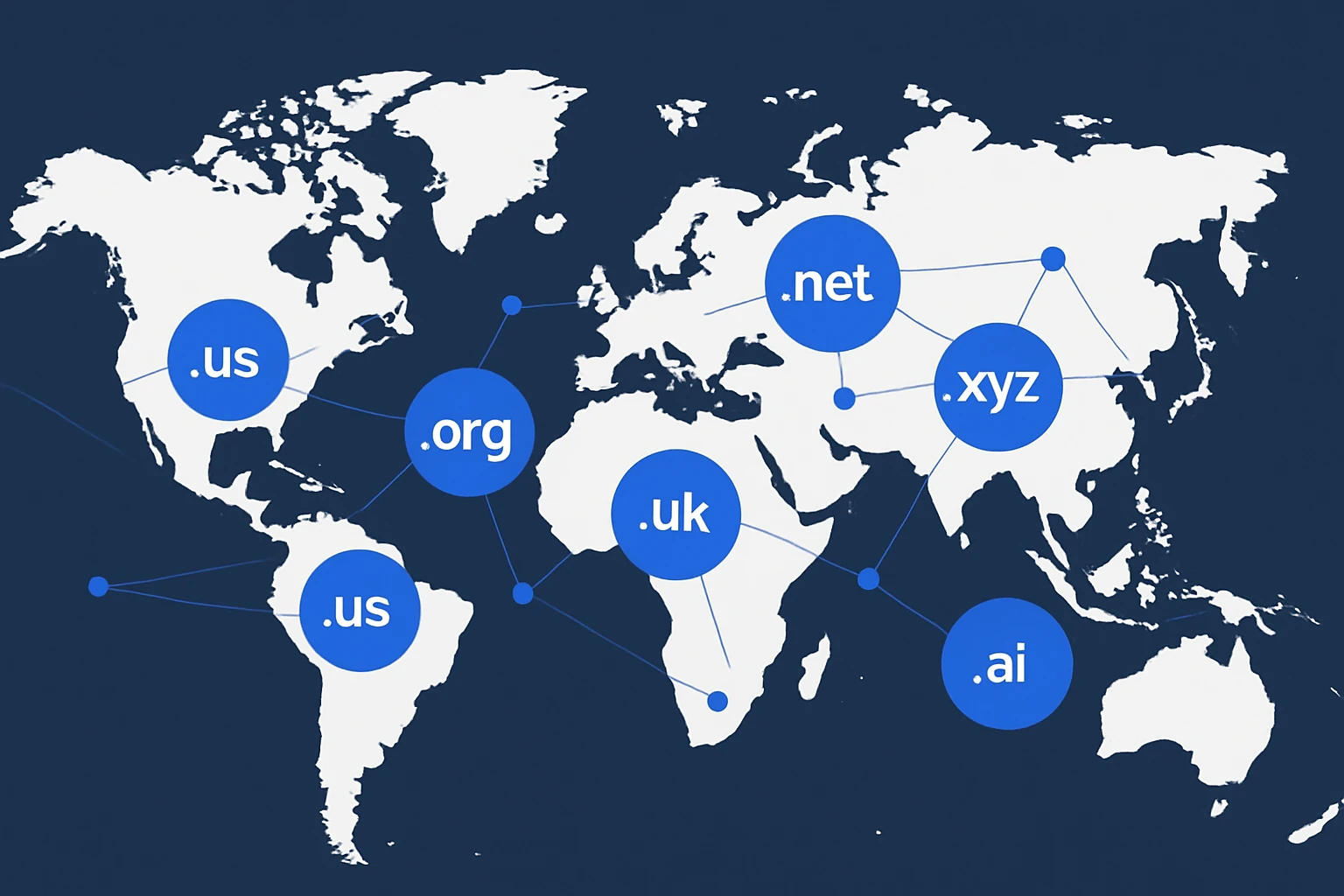
Country code top-level domains (ccTLDs) are two-letter suffixes derived from ISO 3166-1 country codes (for example, .us for the United States, .de for Germany, .uk for the United Kingdom). They’re particularly valuable for brands targeting specific markets, regulators, or consumers in a given country or territory. Importantly, ccTLDs carry implicit geographic relevance in the Domain Name System (DNS) and, in practice, can influence local trust and perceived relevance. For a formal definition, see ICANN’s overview of ccTLDs. ccTLDs. (icann.org)
New gTLDs: expansion opportunities for brands and specific niches
Beyond the traditional .com, new gTLDs were introduced to enable brand-specific and industry-specific domains (for example, .tech, .shop, .online). The next round of new gTLDs is under discussion, with ICANN signaling ongoing progress toward a 2026 application window. This framework of expansion has created opportunities for differentiated branding, geographic strategies, and niche targeting, but it also adds complexity to portfolio management and renewals. For the latest status from ICANN, see the New gTLD Program pages and recent updates. New gTLD Program: 2026 Round. (newgtldprogram.icann.org)
A practical framework: how to decide which TLD fits your goals
Rather than chasing every new option, a disciplined framework helps you align TLD strategy with audience, branding, and risk. Here is concise guidance you can apply across most projects:
- Define your primary audience and geography: Are you aiming for a global audience or a specific country/region? If global, GTLDs like .com remain strong anchors, if focused on a country, consider ccTLDs to signal local relevance. ICANN’s ccTLD definitions provide the structural basis for this decision. ccTLD overview. (icann.org)
- Assess branding needs and portfolio flexibility: If you plan to launch brand-specific products or services (for example, a regional campaign or a product line), a curated set of new gTLDs can help segment offerings while preserving a primary GTLD as the core.
- Consider DNS and technical implications: Different TLD families have different registries, management practices, and DNS security considerations. Understanding these nuances helps reduce operational risk when you scale across multiple TLDs.
- Evaluate renewal risk and cost structure: Portfolio maintenance costs accumulate across multiple TLDs. Industry dynamics show that some registries optimize revenue through renewal pricing, which affects long-term ROI. For context on market dynamics and growth, see the 2024 market review. Domain Name Wire notes 362.3M total registrations with ongoing price considerations. (domainnamewire.com)
A structured decision block: a quick framework you can reuse
The following framework is designed as a reusable decision checklist for teams evaluating a new domain extension or portfolio expansion. It mirrors common decision pathways used by enterprises and brands when budgeting, planning, and measuring impact.
- Step 1 - Audience clarity: List target countries, languages, and user intents. Map these to potential ccTLDs or as global GTLDs with localized sub-pages.
- Step 2 - Brand and product alignment: Does your brand story benefit from a dedicated TLD (for example, a product line or geographic campaign) or is a single global presence sufficient?
- Step 3 - Risk assessment: What are the migration, maintenance, and SEO implications of acquiring multiple TLDs? Consider renewal risk and brand consistency across domains.
- Step 4 - DNS and security readiness: Ensure DNS provisioning, SSL coverage, and monitoring are scalable across chosen TLDs, assess registrar and registry support for each TLD.
- Step 5 - Portfolio governance: Establish ownership, branding guidelines, and renewal calendars to avoid fragmentation and lost assets.
Where readers can explore authoritative domain inventories
For readers who want to explore exhaustive lists and country-oriented domain inventories, consider consulting WebAtla’s directories. Their lists of domains by TLD and by country provide practical references when building a diversified portfolio. WebAtla: List of domains by TLD and WebAtla: List of domains by countries. These resources complement a principled framework like this one by giving concrete examples to inform selection and procurement decisions.
Limitations, trade-offs, and common mistakes
Every TLD strategy involves compromises. Here are the most frequent limitations practitioners encounter and how to mitigate them:
- SEO expectations vs. reality: TLD alone rarely determines rankings, content quality, site structure, and technical SEO matter more. While ccTLDs can signal locale, Google emphasizes signals beyond geography, including content relevance and backlinks. The practical takeaway is to treat TLD selection as part of a broader SEO and content strategy, not a magic lever.
- Portfolio complexity: Adding many TLDs increases maintenance, security, and monitoring burden. Start with a core set that aligns with your audience, then stage incremental expansions with clear governance.
- Brand consistency risk: Inconsistent use of TLDs across regions can dilute brand identity. Develop a governance plan that defines which domains point to which country or product pages.
- Migration and user experience: Redirects and canonicalization must be carefully planned to avoid confusing users and search engines during expansion or consolidation.
A note on the broader ecosystem and timing
The domain ecosystem is evolving. ICANN’s public updates indicate ongoing work toward a new round of gTLDs (the 2026 round) and continued policy discussions around IDNs, branding, and governance. Understanding these processes helps teams align portfolio plans with regulatory timelines and market opportunities. For official program updates, refer to ICANN’s New gTLD Program pages and announcements. New gTLD Program: 2026 Round. (newgtldprogram.icann.org)
Conclusion: a disciplined path to a resilient TLD strategy
Domain extensions are a foundational element of your online strategy. A disciplined approach - grounded in audience geography, branding goals, and DNS readiness - helps you select TLDs that support growth while minimizing risk. The current landscape suggests a measured mix of GTLDs for global reach, ccTLDs for country-specific trust, and selective new gTLDs for brand-led campaigns, all within a governance framework that keeps renewals and security front and center. As the ecosystem evolves toward new rounds and refined policies, a data-informed approach paired with solid operational controls remains your best path to a durable online presence.
For readers exploring domain inventory and country-by-country context, WebAtla’s directory offers practical supplements to this framework. Explore their TLD list at WebAtla's TLD directory and country-specific listings at WebAtla's country lists to ground your decisions in real-world examples.